Why thermal pads matter in Egyptian OEM production
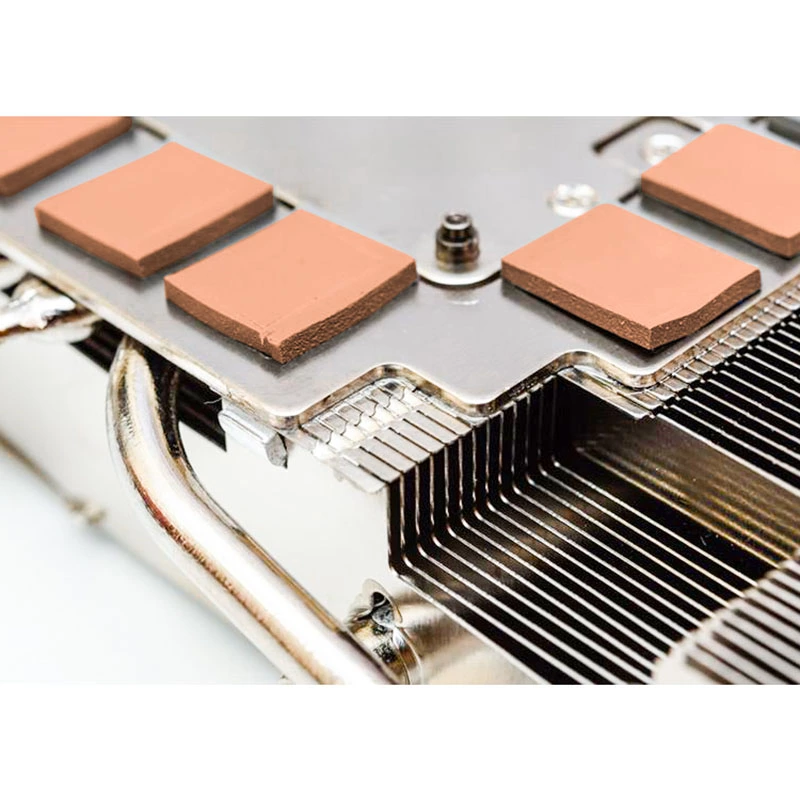
A thermal pad fills the microscopic air gaps between a heat-generating component (SoC, PMIC, RF PA, IGBT) and its heatsink or chassis. Air is a poor conductor; replacing it with a conformable, high-conductivity elastomer dramatically lowers thermal resistance across the joint and reduces junction temperature.
In Egyptian production environments, three factors make pad selection especially consequential:
- High ambient temperatures – Cairo summer peaks around 42 °C, raising the baseline temperature of every active component and shrinking the margin for thermal design error.
- Localization mandates – AOI's partnership with Chinese telecom OEMs explicitly calls for localization of structural, power and thermal components, opening supplier qualification windows for non-core BOM.
- Rising power density – 5G RF modules, fast-charging PMICs and EV traction IGBTs all push more watts through the same footprint, demanding higher conductivity grades.
The four conductivity grades: which one fits your application
Below is a practical mapping of the four mainstream conductivity grades to typical Egyptian OEM use cases.
| Grade |
Typical use in Egyptian OEM |
Recommended thickness |
Key property |
| 3 W/m·K |
Smartphone SoC (mainstream tier), PMIC, RF front-end, routers, STB |
0.5 – 1.0 mm |
Cost-effective, conformable at low clamping force |
| 5 W/m·K |
Performance phones, tablet SoCs, TV mainboard power stages, camera modules |
0.5 – 2.0 mm |
Balanced conductivity and compliance |
| 8 W/m·K |
5G RRU/BBU, optical modules, automotive IGBT, OBC, server CPUs |
0.8 – 3.0 mm |
Suitable for high-power telecom and EV applications |
| 15 W/m·K |
High-density compute, flagship IGBT, AI accelerator modules |
1.0 – 3.0 mm |
Maximum heat extraction where z-height is limited |
For the volume segment of Egypt's smartphone assembly (mainstream-tier SoCs, power management ICs, RF front-end modules), 3 W/m·K pads offer the right balance of thermal performance, conformability and unit economics. At 0.5–1.0 mm thickness, they fill the narrow gap between SoC and shield-can or heatsink without requiring high compressive force—critical for protecting thin PCBs and BGAs during clamping.
When the application moves to performance-tier phones, tablet SoCs, TV mainboard power stages or high-resolution camera modules, 5 W/m·K becomes the pragmatic choice. It also suits the broad range of consumer electronics assembled in Egypt, from routers to set-top boxes.
Egypt's 5G rollout and AOI-led telecom localization demand pads that can handle continuous high wattage. 8 W/m·K pads are well-suited to RRU/BBU RF power amplifiers, optical transceiver modules, and automotive power electronics such as IGBT modules and onboard chargers. At this grade, low silicone oil bleed becomes an important specification—especially for optical modules where siloxane contamination can degrade lens performance over time.
For flagship IGBT modules, AI accelerator cards and high-density server compute, 15 W/m·K pads deliver maximum heat extraction within tight z-height budgets. These are typically higher-cost, filler-rich formulations (boron nitride, alumina or hybrid fillers) and should be evaluated for long-term compression set and electrical isolation.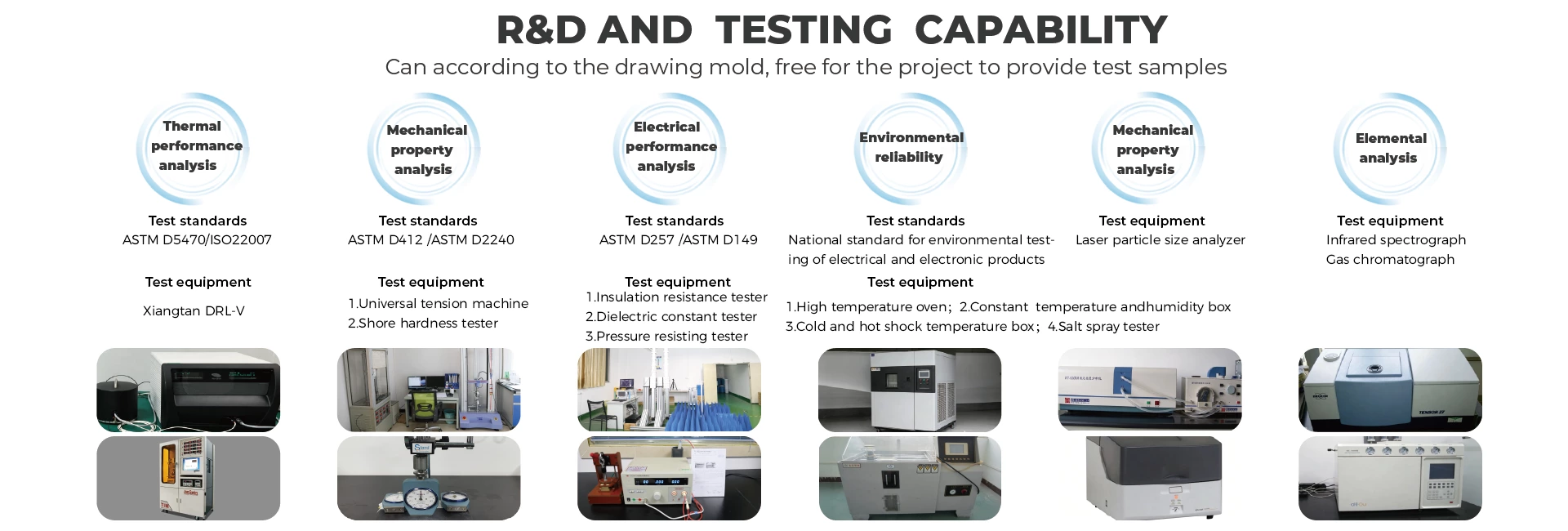
Beyond conductivity: specifications Egyptian OEMs should verify
Conductivity alone does not qualify a pad. Engineering teams evaluating suppliers should request full TDS with third-party test reports referencing:
- ASTM D5470 – thermal resistance (the most important figure for design validation)
- ASTM D2240 – Shore 00 hardness (lower = easier conformability, less component stress)
- ASTM D149 – dielectric breakdown voltage (≥ 6 kV/mm for automotive/telecom)
- ASTM D257 – volume resistivity
- UL 94 – flammability rating (V-0 required for most OEM programs)
- ASTM E595 – total mass loss, critical for optical and aerospace-adjacent applications
What a qualified thermal pad supplier looks like
The pad is only as good as the manufacturer behind it. When qualifying a TIM supplier for Egyptian OEM production, sourcing teams should evaluate four dimensions:
1. Manufacturing scale & vertical integration
A supplier with in-house R&D, compounding, calendering, die-cutting and quality control can ensure batch-to-batch consistency and rapid response to custom formulations. Fehonda operates from a 13,000+ m² manufacturing base in Chenzhou, Hunan, China, with a monthly production capacity of 5,000 tons across its thermal, conductive, microwave-absorbing and adhesive material lines. This scale enables both volume supply for Egyptian mega-programs (e.g., AOI telecom, smartphone CKD lines) and flexible small-batch NPI trials.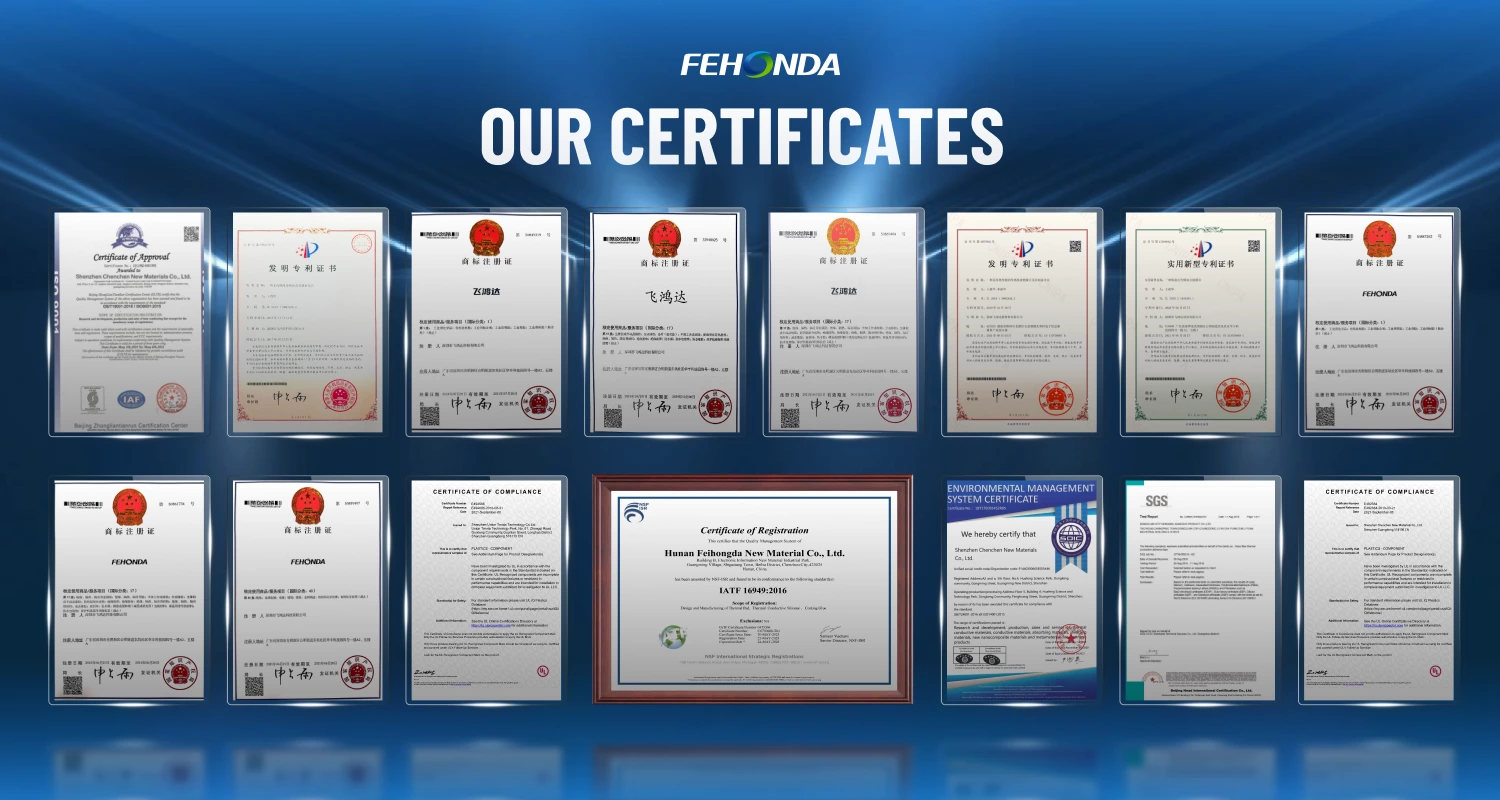
2. System certifications
Beyond baseline ISO 9001 and ISO 14001, automotive and telecom programs require deeper quality systems. Fehonda has passed ISO 9001, ISO 14001, ISO 45001 and IATF 16949—the latter being essential for supplying Tier-1 automotive customers. All Fehonda thermal pads are tested to ASTM D5470, ASTM D2240, ASTM D792, ASTM D374, ASTM D149, ASTM D257 and UL 94 standards.
3. R&D assets and intellectual property
Thermal pad formulation is a materials science discipline. Fehonda brings 20 years of accumulated expertise since its founding in 2007, holds 8 invention patents and 14 utility model patents, and has been recognized as a National High-Tech Enterprise and "Little Giant" Specialized, Refined, Differentiated and Innovative SME. our materials serve leading 5G communication equipment manufacturers
4. Customization capability
Real-world OEM applications rarely fit standard catalog sizes. A qualified supplier should offer:
- Thermal conductivity tuning (1–15 W/m·K range)
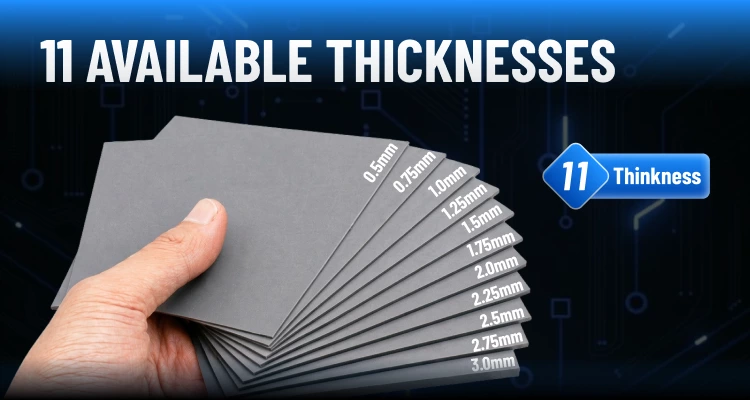
- Thickness from 0.3 mm to 20 mm
- Hardness customization (Shore C 25–55)
- Die-cutting to drawing, single/double-side adhesive options
- Custom packaging and private labeling
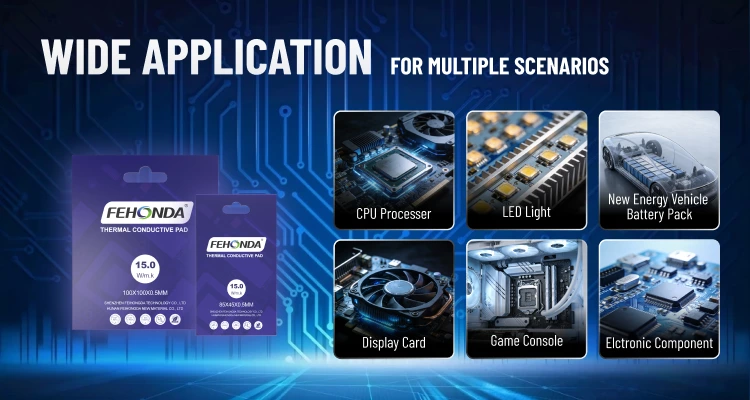
Fehonda's 8.0 W/m·K and 15.0 W/m·K grades are available in multiple thickness variants (0.5/0.8/1.0/1.5/2.0/3.0 mm) with both regular and low-silicone-permeation formulations, enabling precise matching to Egyptian OEM applications from smartphone SoC to 5G base-station RF PA.
Localization, compliance and supply considerations for Egypt
For OEMs producing in Egypt, supplier selection extends beyond the pad itself:
1. Local presence or local partner
A supplier able to provide local die-cutting, stocking or technical support in Egypt dramatically reduces lead time and customs friction. This is particularly relevant for AOI and telecom programs where JIT delivery to the production line is expected.
2. Export & customs readiness
Suppliers serving Egypt must support:
- ACID (Advanced Cargo Information Declaration) encoding prior to shipment
- NAFEZA system documentation via CargoX
- Certificate of Origin (China–Egypt) for tariff preference
- Full English documentation with harmonized HS classification
3. Sampling and NPI support
A qualified supplier should offer free samples, custom die-cutting to drawing, and engineering collaboration during the NPI phase—especially valuable for first-time localizations where thermal design margins are still being validated.
4. Field-proven reliability
Fehonda thermal pads have been deployed in demanding environments—from 5G base stations to EV power electronics—and have demonstrated long-term stability under high load. Our 8.0 W/m·K grade, for example, is rated for continuous operation from -40 °C to 180 °C with V-0 flammability, making it well-suited to Egypt's extreme ambient conditions when properly integrated into the thermal design.
How to run a successful pad evaluation
Egyptian OEM engineering teams should follow a structured path:
- Define the thermal budget – calculate allowable junction temperature rise and required thermal resistance.
- Select preliminary grade – use the table above as a starting point.
- Request samples with full TDS – insist on ASTM D5470 thermal resistance values, not just conductivity.
- Prototype and measure – instrument the actual assembly and measure junction temperature under Egyptian ambient (40 °C+) conditions.
- Validate longevity – compression set and silicone bleed testing for the target product lifecycle.
- Qualify for production – lock specifications, agree on local stocking, and formalize the supplier in the BOM.
Key takeaways for Egyptian OEM sourcing teams
- Match the conductivity grade to the application: 3 W/m·K for mainstream mobile, 5 W/m·K for performance consumer electronics, 8 W/m·K for telecom/automotive power, 15 W/m·K for maximum-density compute.
- Conductivity is only one metric—verify thermal resistance per ASTM D5470, hardness, dielectric strength and flammability.
- For Egyptian production, prioritize suppliers with local support, customs readiness (ACID/NAFEZA) and full certification portfolios.
- Look for suppliers with proven scale (e.g., 13,000+ m² manufacturing base, 5,000-ton monthly capacity), deep system certifications (IATF 16949 included), and field-proven deployment in 5G and automotive programs.
- Run a structured NPI evaluation with on-site thermal validation under local ambient conditions.
About Fehonda:
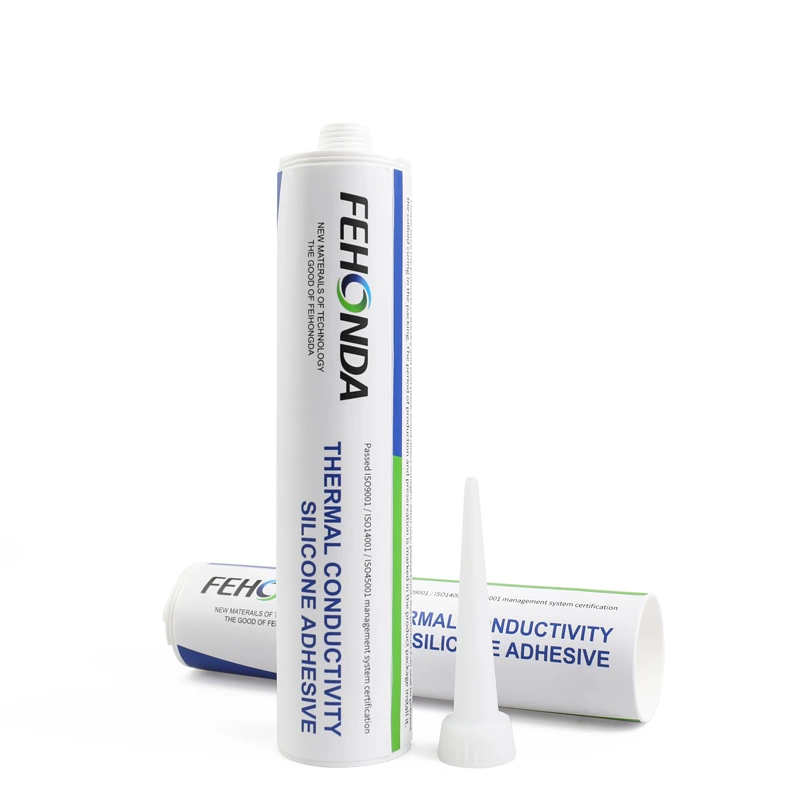
Fehonda was founded in 2007 and is headquartered in Shenzhen, China, with a 13,000+ m² manufacturing base in Chenzhou, Hunan. A National High-Tech Enterprise and "Little Giant" Specialized, Refined, Differentiated and Innovative SME, Fehonda specializes in functional new materials across four product families: thermal management, electromagnetic shielding, microwave absorption, and adhesives. The company holds 8 invention patents and 14 utility model patents, and has passed ISO 9001, ISO 14001, ISO 45001 and IATF 16949 certifications. With a monthly production capacity of 5,000 tons, Fehonda supplies thermal interface materials to leading 5G communication equipment manufacturers and automotive Tier-1 suppliers, and serves customers across communication, consumer electronics, automotive electronics, medical, industrial and military sectors. Fehonda thermal pads are available in conductivity grades from 1 to 15 W/m·K, with full customization in thickness, hardness, size and packaging.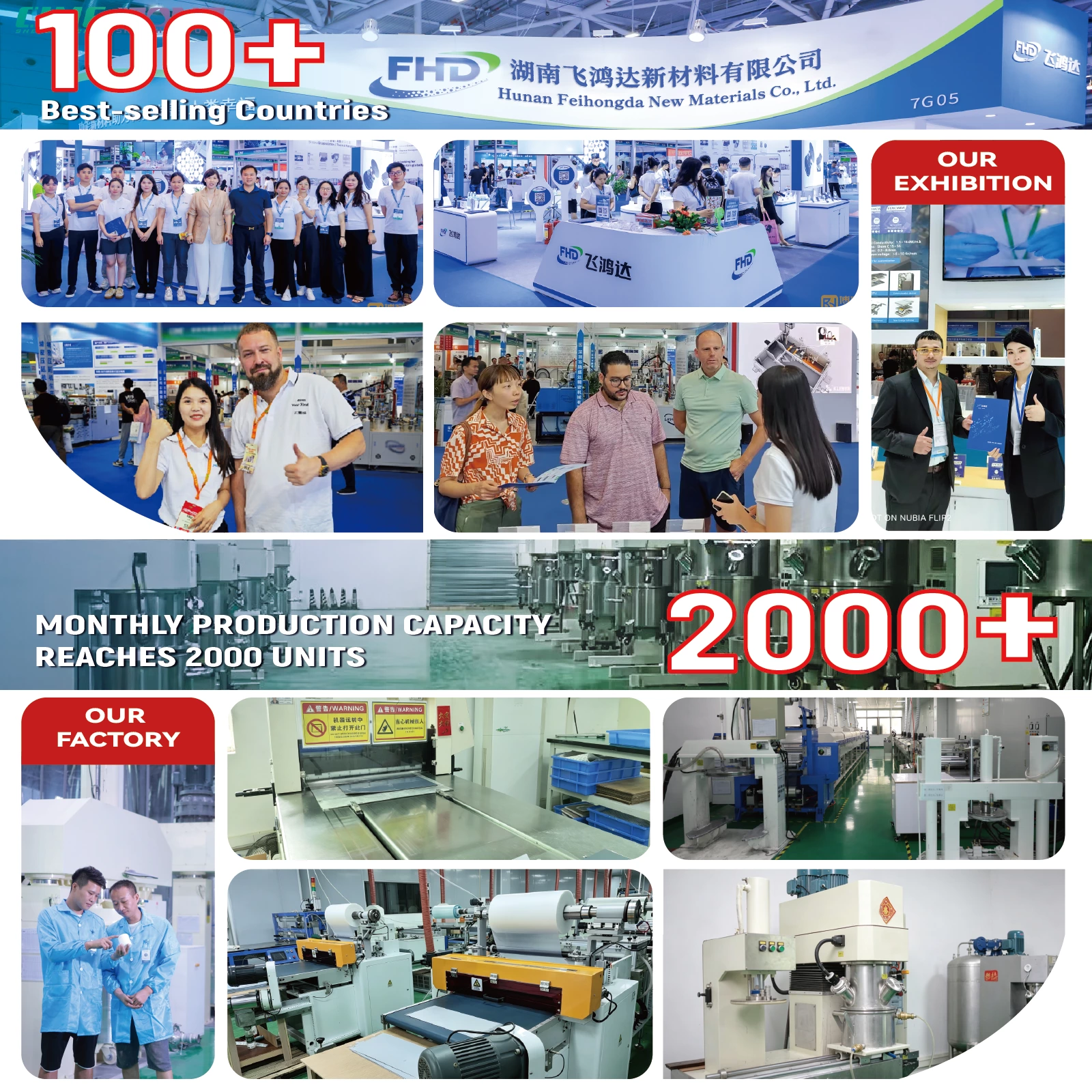
Call to action:
Ready to qualify Fehonda thermal pads for your Egyptian production line? Contact our application engineering team for grade recommendation, free samples, full TDS with third-party test reports, and local logistics support.