A dash cam is a small sealed box fixed to the windscreen behind the mirror, with no fan, a plastic housing, a 4K encoder running continuously and a lens that must stay optically clean. A hardwire kit keeps parking mode alive after the ignition is off, so the worst condition is not a fast drive on a hot road — it is a stationary car in direct sun with the electronics still running. Industry-reported measurements put windscreen-adjacent surface temperatures in the 70 to 90 °C range, while most consumer dash cams are specified to about 60 to 70 °C. That gap is the whole design problem. The premium tier's move to supercapacitors instead of lithium cells buys thermal headroom, but it does not remove the heat.
Thermal Materials for Dash Cameras
The hour nobody is watching
Three moments decide whether the material specification is right, and none is the first day on a bench. First, the hot park: solar load raises the housing and 4K encoding adds a few watts on top; the processor throttles, bitrate and frames drop, and thermal protection shuts the unit down until it cools. Morning footage is clean, afternoon footage bands or simply stops. The customer usually blames the memory card.
Second, night. Every CMOS pixel produces a dark current even in total darkness, indistinguishable from signal, and it rises exponentially with sensor temperature — roughly doubling for every 6 to 8 °C rise. Night is when the recording matters most and when a warm sensor has the least margin. Third, the second summer: interfaces dry out or get pumped out by daily cycling, capacitors lose roughly half their life per 10 °C rise, and the mount adhesive slowly creeps. By then the design has been in production for a year.
Where the heat is allowed to go
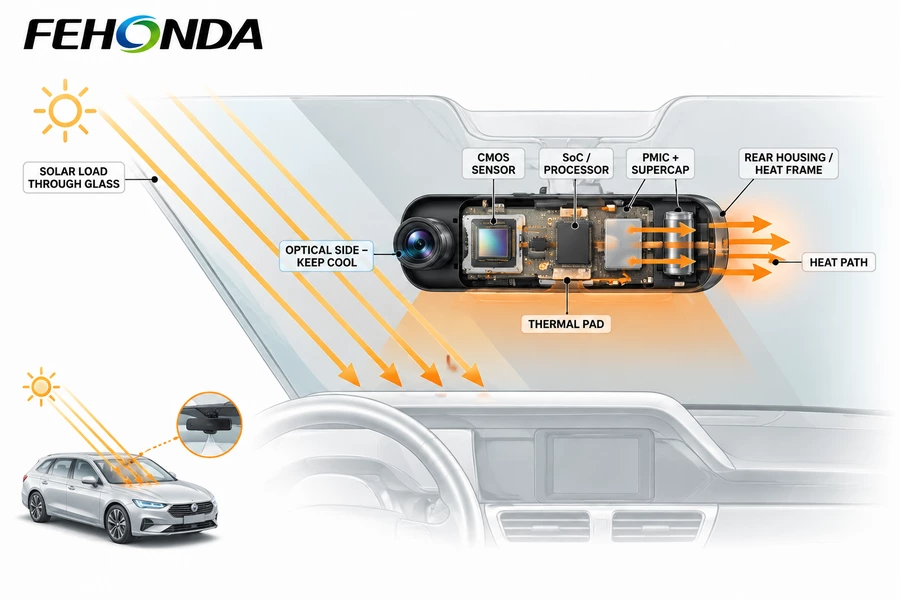
Figure 1. Solar load through the glass, internal heat sources, and the two directions the design must keep separate.
The image processor and the image sensor usually sit close together under one shield, and the only real heat sink available is the rear housing or a metal mid-frame. There is one permitted direction — from the processor backward into the housing and out to cabin air — and one forbidden direction: sideways into the lens and the sensor.
That second rule is easily broken by an otherwise sensible idea. Spreading heat is normally good practice, but a spreader plate that carries processor heat toward the optical stack raises sensor temperature and with it the dark current. It also heats the lens barrel, where a different mechanism takes over: in a sealed optical cavity, low-molecular-weight siloxanes released by ordinary silicone materials migrate through the internal air and condense on the coldest optical surface — usually the inside of the lens or the filter, not the hot component everyone inspects. A thin film there shows up weeks later as fogging, soft contrast or colour cast. In this product, low outgassing is a selection criterion before conductivity is. The housing is also a surface the user touches when pulling the memory card, and IEC 62368-1 sets touch temperature limits for accessible parts, so it cannot serve as an unlimited radiator.
The material map
FEHONDA supplies thermal pads, gels, silicone rubber, RTV sealants, potting compounds, composite TIM constructions and conformal coatings from 1.5 to 6.0 W/(m·K). The table assigns them to positions in a compact, fanless, sealed camera.
| Position | FEHONDA material | Why this position |
| Image processor / encoder to rear housing or mid-frame | Low-oil, low-volatility thermal pad, 1.5 to 3.0 W/(m·K); ultra-soft 2 to 3 W/(m·K), Shore 00 25 to 35 where pressure is low | The main conduction path out of the box. Low outgassing protects the sealed optical cavity; low assembly force protects the optical stack |
| Uneven components near the sensor module | Thermal gel, 1 to 3.5 W/(m·K), Shore 00 40 to 75 | Fills the real gap under a shield at low pressure, wets irregular parts and suits automated dispensing. A cut pad bridges only the gap it was cut for |
| PMIC, DC-DC stage and supercapacitor stack | Thermally conductive RTV silicone, 1 to 2 W/(m·K) | A heat path and mechanical retention in one step on irregular parts, held through road vibration |
| Housing seam and main cavity joint | Flame-retardant RTV silicone sealant | Keeps moisture and condensation out through daily heat cycling while remaining serviceable |
| PCB, board level | UV or RTV conformal coating | Humidity and condensation protection. It does not fill gaps and is not a thermal interface |
| Board to housing, wide gaps | Soft thermal pad or gel, 1.5 to 2.0 W/(m·K) | A broad contact area into the housing is often the cheapest improvement available in a sealed plastic box |
| Whole main board | No full potting recommended | A sealed optical cavity plus a non-reworkable fill traps volatiles near the lens. Keep potting, if used, to a separate power sub-assembly |
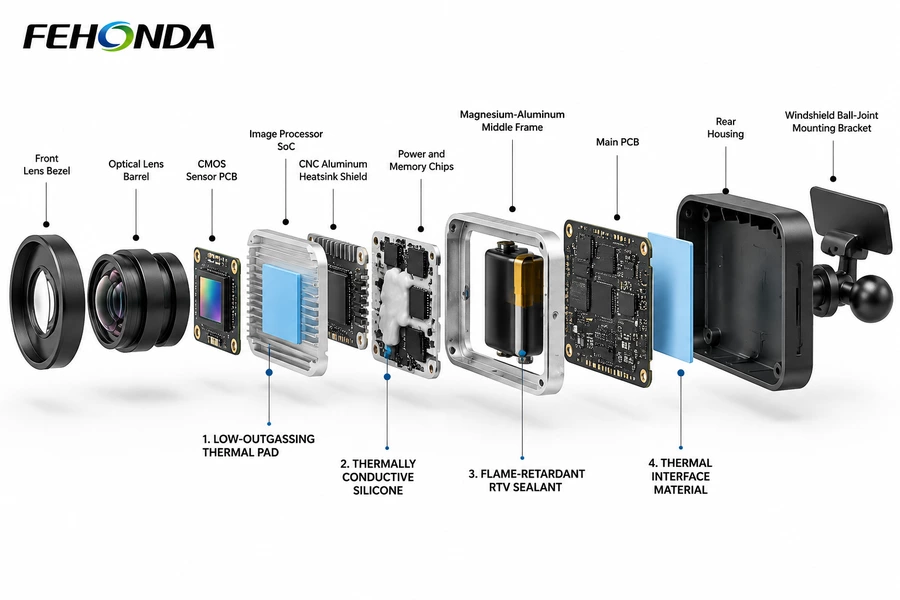
Figure 2. Material positions from lens and sensor through to the rear housing, with the optical cavity kept separate.
Two grades sit outside this map. Carbon fibre pads at 25.0 and 35.0 W/(m·K) through-plane are built for concentrated hotspots with a validated conduction path; a plastic dash cam housing cannot reject that much heat. Nor does the highest standard grade usually earn its cost, because the enclosure wall and the surface-to-air step dominate the resistance chain. Measure the temperature drop across each segment before moving up. If vehicle-harness noise is a measured problem, a wave-absorbing sheet may be evaluated at the shield can — kept out of the GPS and Wi-Fi antenna keep-out zones, and given its own heat path, since an absorber turns electromagnetic energy into heat.
Before the specification is frozen
Ask for thermal resistance at the bond line and assembly pressure actually used, not conductivity alone. Name the hardness scale explicitly — Shore 00 is not Shore A, and a number without its scale is not a specification. For low outgassing, request measured volatility data with its test conditions rather than the word low; the same applies to dielectric strength near a supply rail and to the flame classification at the thickness you intend to buy. The UV conformal coating specification used across automotive programmes is a useful template: insulation resistance after 40 °C / 93% RH for 24 to 168 hours, electrical performance after 85 °C / 85% RH for 1,000 hours, and post-ageing appearance and adhesion alongside cure time. Ask for retained values, not only as-new ones.
Keep three items off the material bill. A microSD card that throws write errors in heat is a storage specification; a lithium cell that swells is a power-source decision; a mount adhesive that creeps at 60 to 70 °C is a mechanical one. Free measures come first: put the camera in the mirror's shadow, clear of the windscreen boundary layer, and use a sunshade. Those lower the baseline more than any interface material can.
Why FEHONDA
One supplier covers the full 1.5 to 6.0 W/(m·K) ladder in pads, gels, silicone rubber, RTV sealants, potting compounds and conformal coatings, so a platform with front, cabin and rear channels does not need several vendor qualifications. Those layers also sit against one another inside a very small sealed volume: an RTV cure by-product, a pad liner release agent or an uncured gel can migrate into a neighbouring layer and change its adhesion or insulation. Keeping them with one supplier makes that an engineering question rather than a question of responsibility.
Pads are die-cut to the drawing, with thickness matched to the measured gap, hardness selected on the Shore 00 scale, colour coding to separate grades on the line, single- or double-sided liners, and kitting by position. Samples turn around quickly, small-batch orders are accepted for pilot builds, and a revised drawing produces a revised sample rather than a new negotiation. RoHS and REACH declarations with supporting test reports are available on request. For a small or mid-sized team the practical difference is access: the people making the material are the ones answering the question.
Send the housing drawing, the gap and assembly pressure at each position, the sensor and encoder load, the parking-mode duty cycle and your production volume. We will return a material map, a grade shortlist, samples and a lead time — including the positions where no material is needed. Please submit your request via our custom service form to ensure a faster response.