FHD-EP2530 Two-Part Epoxy Potting Compound
FEHONDA | Product Application Guide
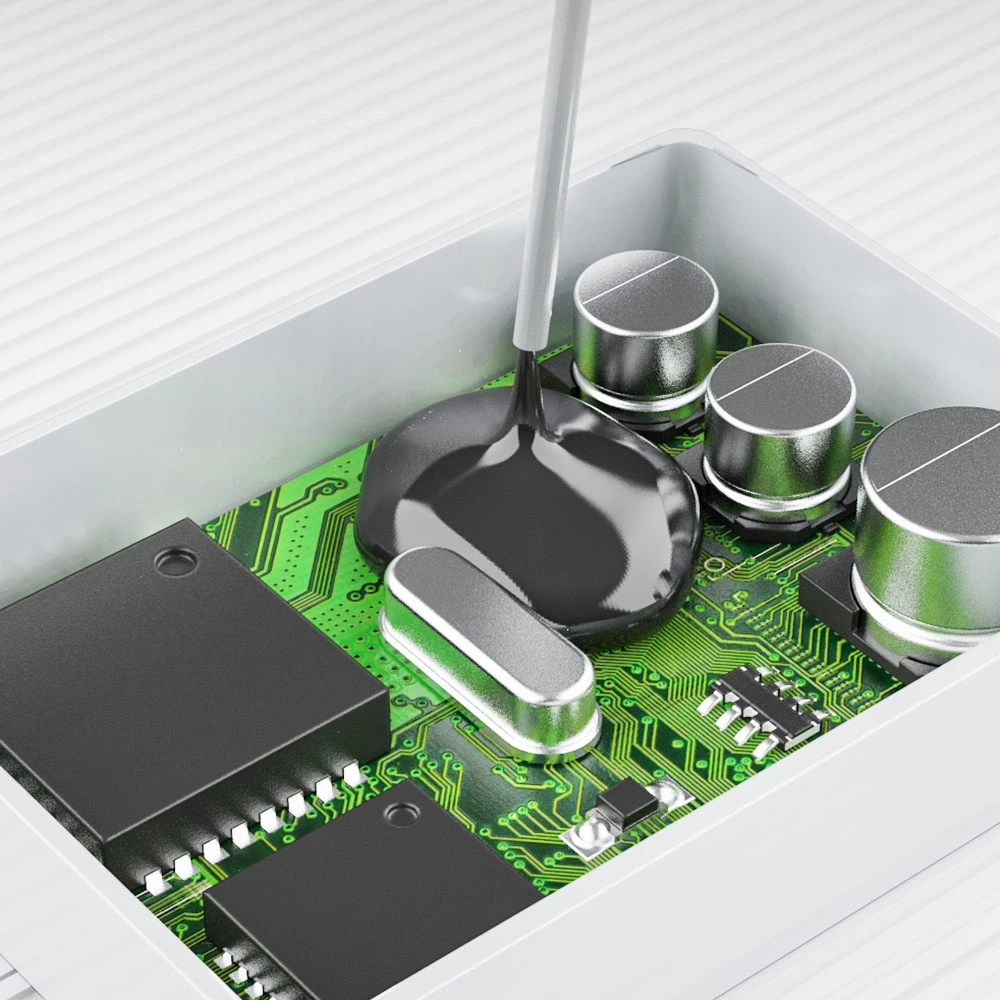
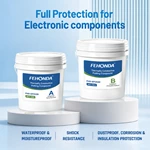
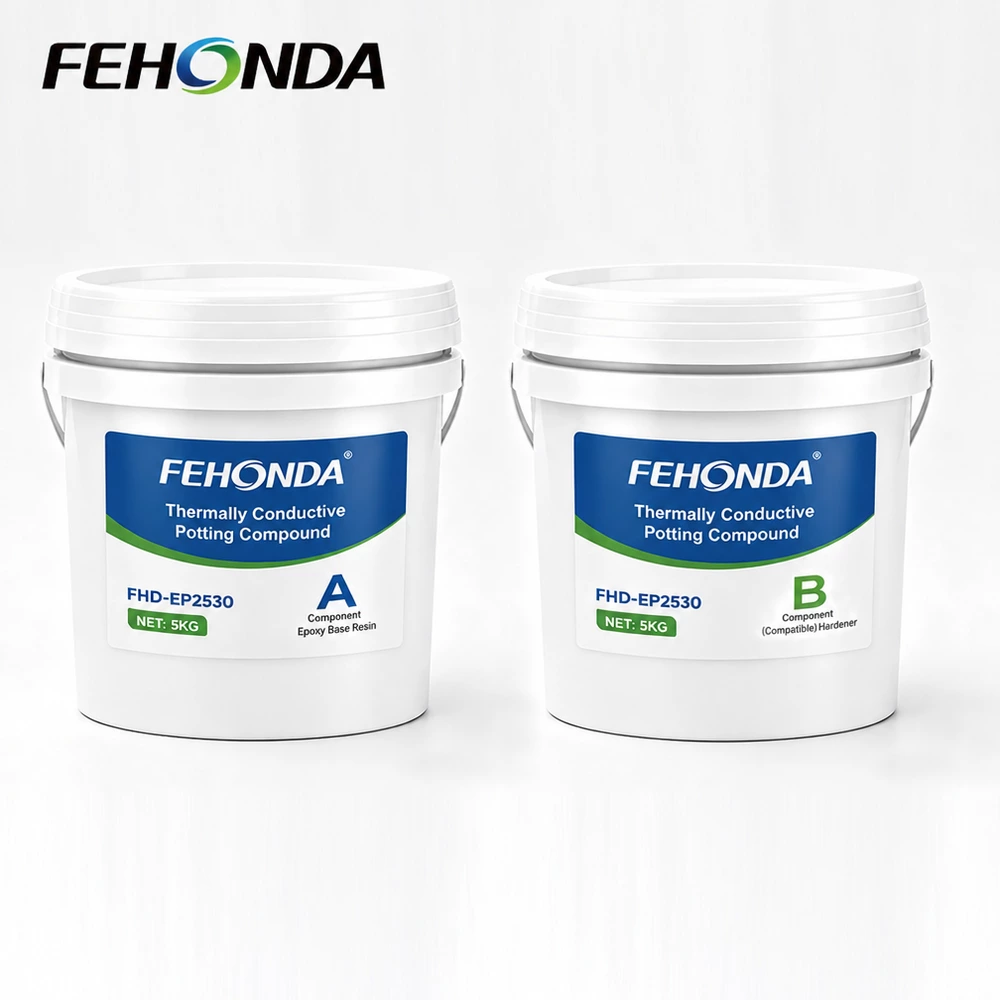
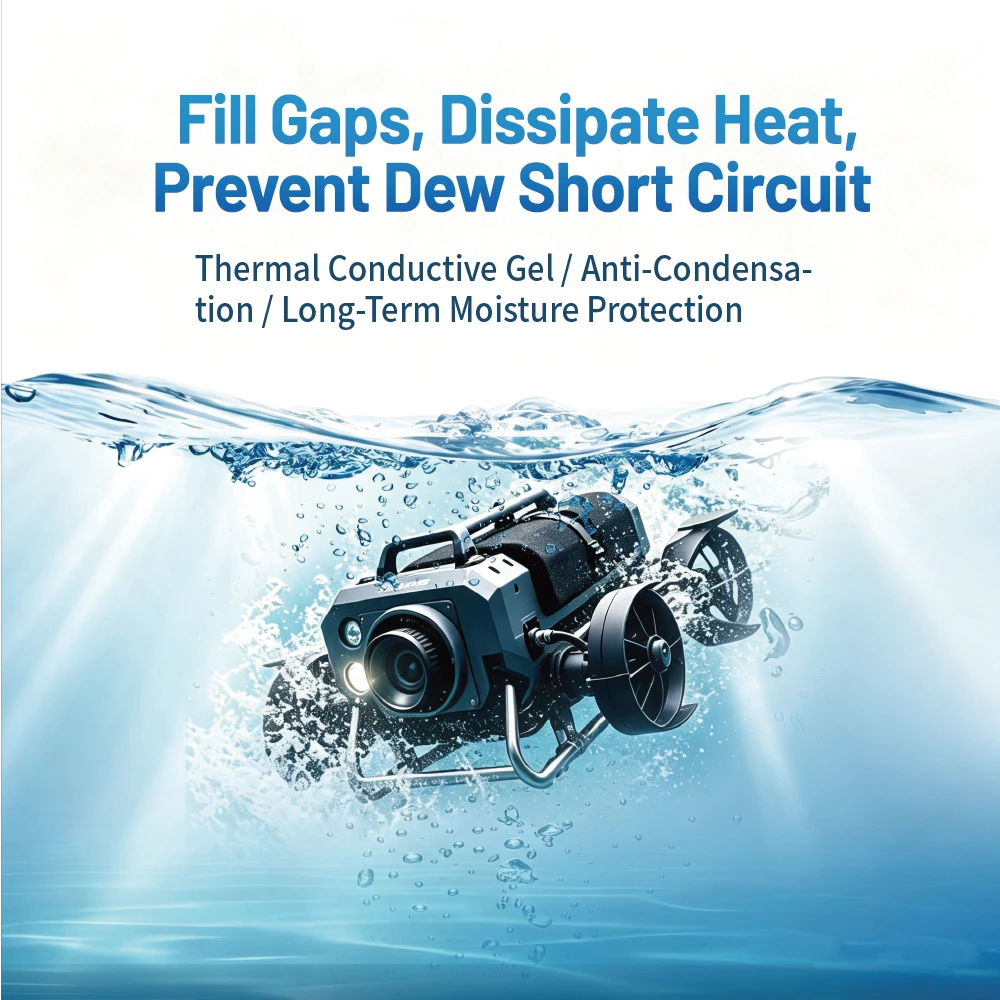
FHD-EP2530 is a two-part epoxy structural adhesive supplied in a dual A/B cartridge. It is formulated for one job done four ways at once: conducting heat away from a component, insulating it electrically, bonding it in place, and sealing it against the environment.
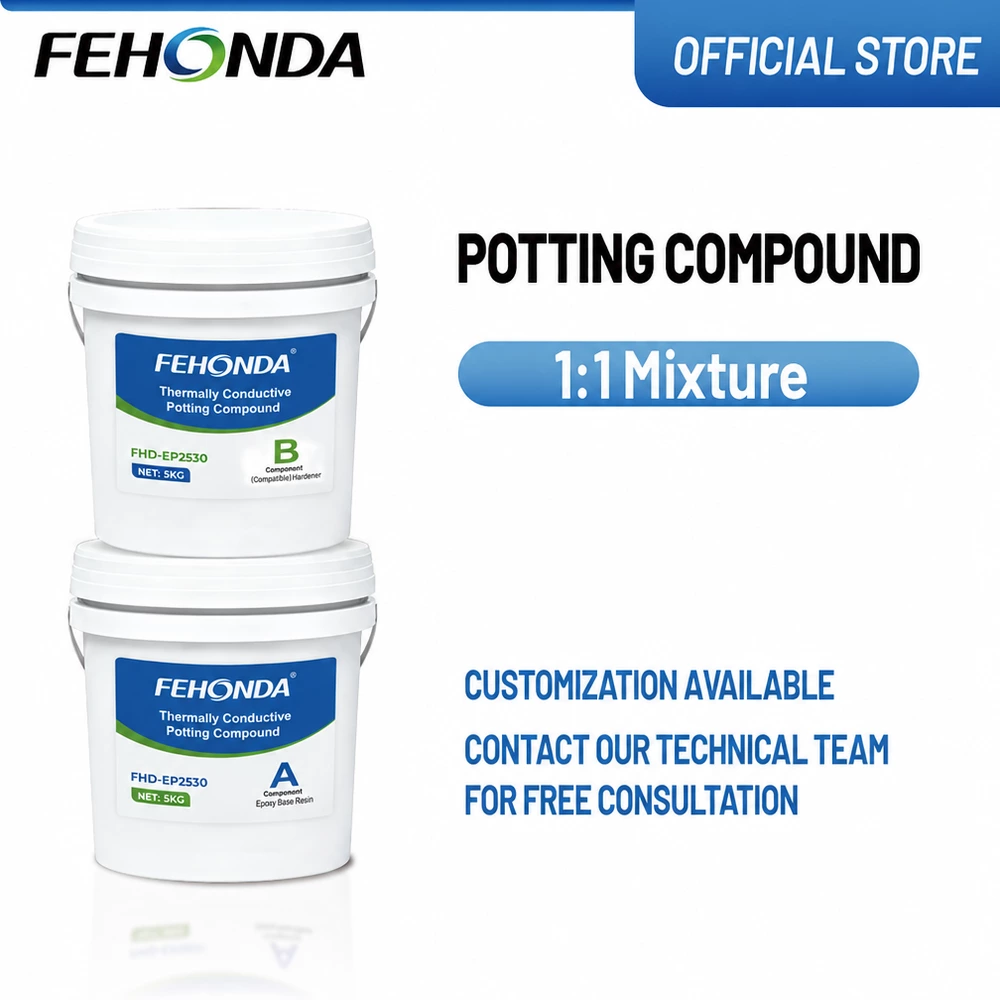
The two components are supplied at a 1:1 mix ratio by weight. Part A is natural in colour and Part B is red, which is deliberate — the colour contrast makes an incompletely mixed batch visibly streaked before it ever reaches a production part. The system cures at room temperature or under heat, reaches a UL94 V-0 flame rating when cured, and is RoHS compliant.
Because it is an epoxy rather than a silicone, it cures to a hard, rigid, structurally supportive solid. That single property decides most of where it should and should not be used, and Section 3 deals with it in detail.





FEHONDA | Product Application Guide
A 1:1 thermally conductive encapsulant — specifications, application scope, step-by-step procedure and test method
1. Full specification
The tables below reproduce the product performance data as stated in the FEHONDA datasheet. Values are typical figures obtained under standard laboratory conditions on fully cured specimens; confirm against the current datasheet before design work.
Cured properties
| Property | Unit | Value | Test method |
| Thermal conductivity | W/(m·K) | 3.0 | ASTM |
| Hardness | Shore D | 75 | ASTM D2240 |
| Density | g/cc | 2.75 | ASTM |
| Dielectric strength | kV/mm | 18.26 | ASTM D149 |
| Volume resistivity | Ω·cm | 3.06 × 10¹¹ | ASTM D257 |
| Tensile strength | MPa | 10.96 | ASTM D638 |
| Elongation at break | % | 17.42 | ASTM D638 |
| Adhesion strength | MPa | 8.01 | ASTM |
| Flame rating | — | V-0 | UL 94 |
| Service temperature range | °C | –40 to +180 | — |
Key Parameters Explained
Three values are most often misinterpreted:
- Thermal conductivity (3.0 W/m·K): High for potting compounds. Requires heavy ceramic filler, which also drives density (2.75 g/cc) and hardness (Shore D 75). Conductivity, density, and hardness correlate directly.
- Dielectric strength (18.26 kV/mm): Confirms insulating, not conductive. Value is thickness-dependent—use specimen data, not linear scaling to your wall thickness.
- Hardness & elongation (Shore D 75, 17.42%): Hard but not brittle. Provides mechanical support; rigid system informs the key selection question
2. Application scope
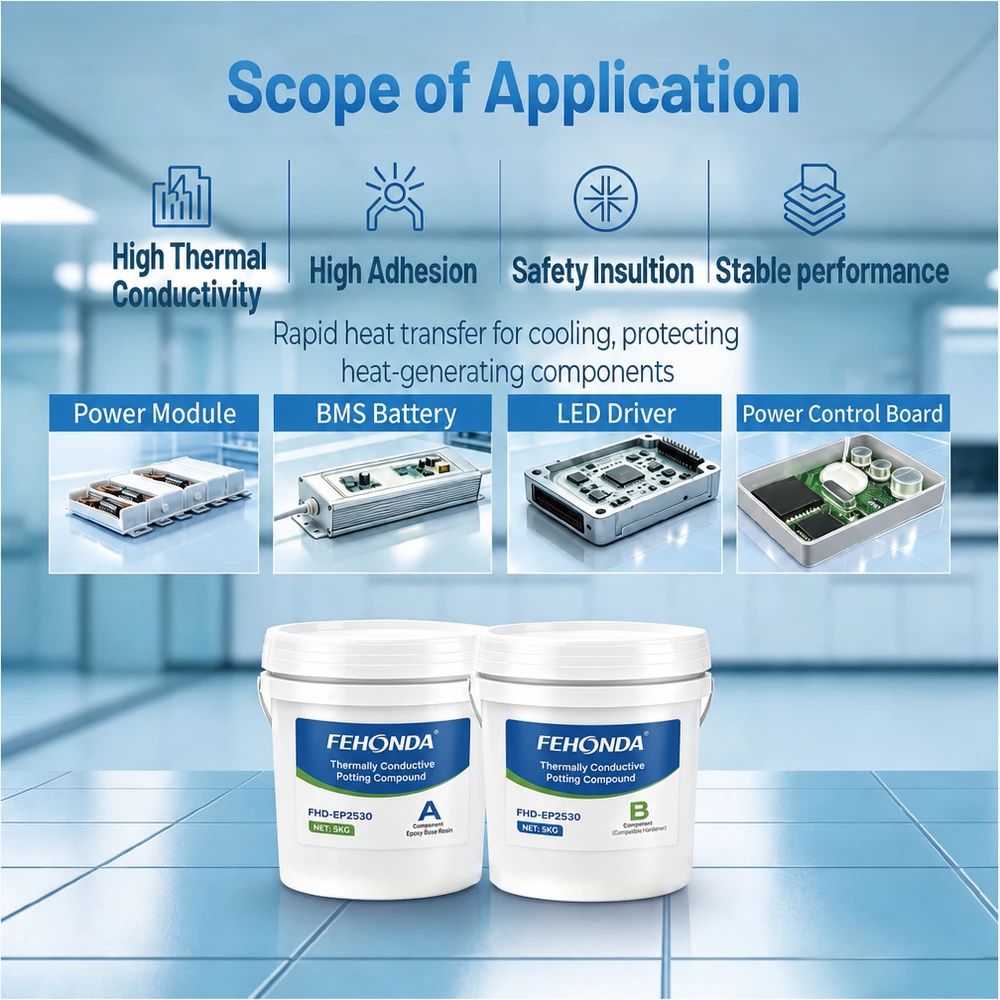
FHD-EP2530 is specified wherever an assembly needs heat moved out, voltage blocked, and the contents locked against vibration and moisture in a single operation. The following six areas cover the bulk of its use.
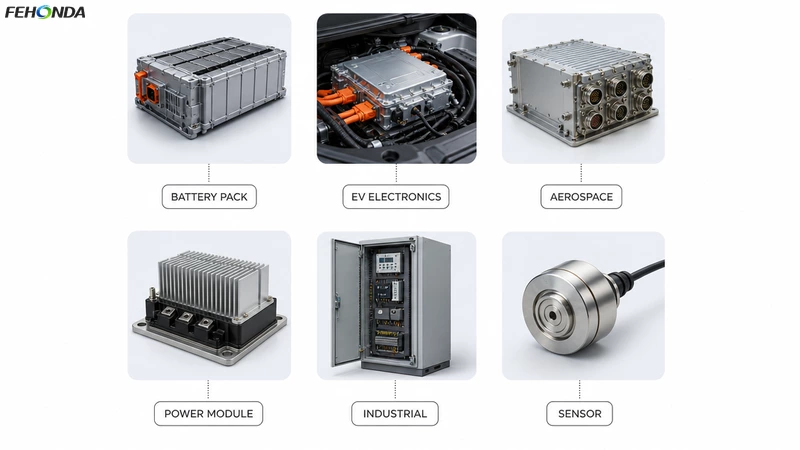
Figure 1. Six principal application areas for FHD-EP2530.
| Area | Typical potted assembly | What the compound delivers |
| New energy battery | Battery management system boards, cell interconnect and sensing modules, module-level electronics | Conducts cell and BMS heat to the housing, insulates at pack voltage, seals against humidity, and locks connections against vehicle vibration |
| EV power electronics | On-board chargers, DC/DC converters, distribution units, motor controller sub-assemblies | Bridges heat from power stages to a cold plate or enclosure while providing isolation and structural support |
| Aerospace and aviation | Avionics modules, power supplies, sensor and control electronics | Cure-depth capability and wide service temperature range, with flame rating and low-risk sealing in sealed enclosures |
| Power modules and supplies | IGBT and MOSFET modules, transformers, inductors, industrial converters and inverters | Fills irregular cavities around magnetics and semiconductors, removes trapped air, and adds a dielectric barrier |
| Industrial control | PLC and drive boards, instrumentation, harsh-environment controllers | Moisture, dust and chemical resistance plus mechanical protection for field-mounted electronics |
| Sensors and connectors | Automotive sensors, cable glands, sealed connectors, small encapsulated assemblies | Small-format packaging suits low-volume and repair work; bonds and seals in one step |
Two criteria cut across all six. First, the assembly benefits from a rigid, load-bearing encapsulant rather than a soft, stress-relieving one. Second, the geometry is a cavity that can be filled — potting works where a pad or a gel cannot reach.
3. Epoxy or silicone: choosing the right potting chemistry
This is the decision that most often determines whether a potting programme succeeds, and it is worth stating plainly: FHD-EP2530 is an epoxy, and epoxy is not the right answer everywhere.
| Consideration | Epoxy (FHD-EP2530) | Silicone potting compound |
| Cured state | Rigid, hard, structurally supportive | Soft, elastic, stress-relieving |
| Hardness | Shore D 75 | Typically Shore A to Shore 00 range |
| Adhesion and bonding | High; contributes structural strength | Moderate; primarily sealing |
| Thermal conductivity | 3.0 W/(m·K) | Commonly 1.0–3.0 W/(m·K) |
| Service temperature | –40 to +180 °C | –50 to +200 °C or wider, grade dependent |
| Stress on components | Transmits shrinkage and thermal movement | Absorbs shrinkage and thermal movement |
| Reworkability | Essentially not reworkable | Often cut out and reworkable |
| Best chosen when | Rigidity, adhesion and structural support are wanted | Stress-sensitive components, wide thermal swings, or future rework is expected |
4. Step-by-step: how to use FHD-EP2530
The procedure below follows the FEHONDA instructions for use and storage. Deviating from it, particularly on mixing, is the single largest cause of potting defects.
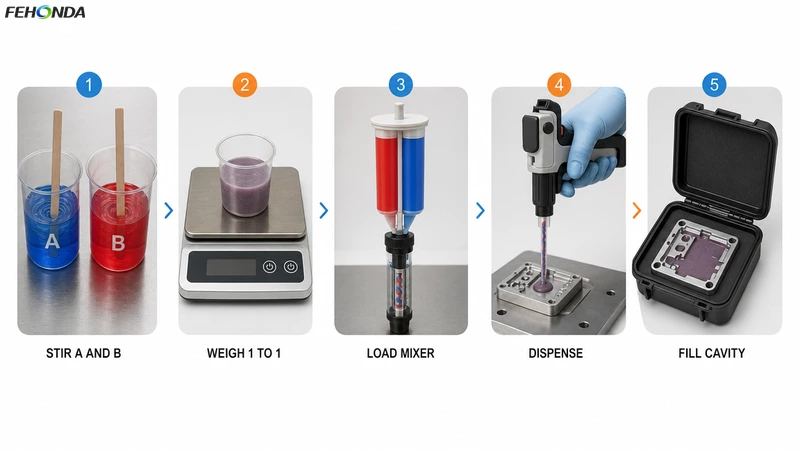
Figure 2. The five-step potting procedure, from component preparation to filled cavity.
Step 1 — Prep: Stir Part A and Part B thoroughly in their original containers (settling degrades thermal performance). Bring to room temperature before opening if stored cool.
Step 2 — Mix (1:1 by weight): Weigh accurately using a scale. Mix slowly, scraping sides and bottom until color is uniform (A is natural, B is red — no streaking). Fast mixing traps air and shortens pot life.
Step 3 — Dispense: Use a manual gun or metered dual-cartridge with static mixer. Purge upward first to expel air, then dispense slowly into the lowest cavity point to avoid voids.
Step 4 — Cure: 25°C for 24h + 80°C for 1h, or 80°C for 2h (cure depth >90%).
Step 5 — Test: Only after full cure. Partial cure yields false hardness, adhesion, and electrical readings.
5. How to test it
Potting compounds are tested on cured specimens prepared under the same mixing and cure conditions as production. The table below maps each datasheet property to the method behind it.
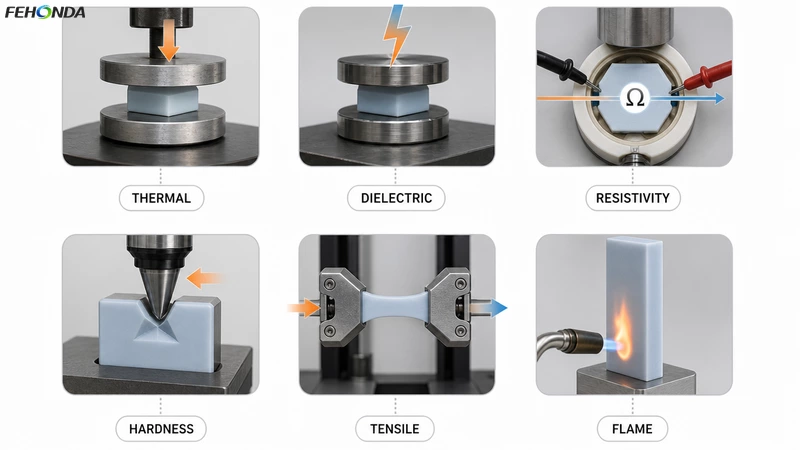
Figure 4. The six property groups measured on a cured potting specimen, and the method behind each.
| Property | Method | What the test does | Why it matters here |
| Thermal conductivity | ASTM | Measures steady-state heat flow through a cured specimen of known thickness | Confirms the 3.0 W/(m·K) heat path actually exists in your cured part |
| Hardness | ASTM D2240 | Presses a defined indenter into the surface and measures resistance to indentation | A fast cure-completeness and lot-consistency check; a soft reading usually means under-cure or ratio error |
| Dielectric strength | ASTM D149 | Ramps voltage across a specimen between electrodes until breakdown occurs, then divides by thickness | Confirms the insulation claim; result is thickness-dependent, so compare like with like |
| Volume resistivity | ASTM D257 | Measures leakage current through the body of the material | Confirms the 3.06 × 10¹¹ Ω·cm barrier against leakage through the encapsulant |
| Tensile strength and elongation | ASTM D638 | Pulls a dumbbell specimen to failure, recording peak stress and elongation at break | Confirms 10.96 MPa and 17.42% — hard but not brittle |
| Flame rating | UL 94 | Applies a standard flame to a vertical specimen and measures after-flame time and dripping | Confirms V-0; note the rating is certified at a specific thickness |
For production qualification, the above are supplemented by assembly-level testing rather than coupon testing: thermal cycling, damp heat, vibration and, where the assembly is sealed, leak or insulation-resistance checks on the finished unit. Qualify the potted assembly, not just the compound.
6. Packaging and selection
FHD-EP2530 is supplied in paired A/B containers across four sizes, spanning manual work through to production volume.
| Pack size | Intended use | Notes |
| 25 mL × 2 | Prototype, laboratory trials, repair and rework | Smallest entry point; suits hand dispensing |
| 200 mL × 2 | Pilot runs, small-batch production | Standard dual-cartridge format for bench dispensing guns |
| 20 L × 2 | Production volume | Bulk supply for metered dispensing equipment |
| 200 L × 2 | High-volume manufacturing | For dedicated metering and mixing lines |
7. Working with FEHONDA
FEHONDA supplies thermal conductive potting adhesive, thermally conductive silica, thermally conductive gel, thermal pads, composite TIM constructions and UV-curable conformal coatings for new energy vehicles, power electronics and industrial assemblies.
Our sales and engineering support teams can help with grade selection, dispensing trials, cure schedule development, void and adhesion troubleshooting, compliance documentation and product customisation. Tell us your cavity geometry, substrate materials, thermal budget, voltage requirement and production volume, and we will come back with a recommendation, sample terms and lead time.
8. Frequently asked questions
What is the mix ratio of FHD-EP2530?
1:1 by weight. Weigh both parts on a scale rather than estimating by volume; Part A is natural in colour and Part B is red, so a fully uniform colour confirms the mix is complete.
Can FHD-EP2530 cure at room temperature?
Yes. Full cure at a constant 25 °C takes 48 hours per the datasheet. Production schedules shorten this to 25 °C for 24 hours followed by 80 °C for 1 hour, or 80 °C for 2 hours.
What thermal conductivity does it achieve?
3.0 W/(m·K) as cured, measured per the datasheet method. That places it well above unfilled or lightly filled potting compounds, which typically fall below 1 W/(m·K).
Is it electrically insulating?
Yes. Cured dielectric strength is 18.26 kV/mm and volume resistivity is 3.06 × 10¹ Ω·cm. Note that dielectric strength is thickness-dependent, so confirm the value at your section thickness.
How hard does it cure?
Shore D 75. This makes it a rigid, structurally supportive encapsulant. If your assembly needs stress relief rather than support, a silicone potting compound is usually the better choice.
What temperature range does it cover?
–40 °C to +180 °C service temperature, with a UL94 V-0 flame rating.
How should I test a potted sample?
Only after full cure. Test hardness as a quick cure check, then thermal conductivity, dielectric strength and volume resistivity on properly prepared specimens of defined thickness, following ASTM D2240, D149 and D257 respectively.
What pack sizes are available?
25 mL × 2, 200 mL × 2, 20 L × 2 and 200 L × 2, covering prototype work through high-volume production.