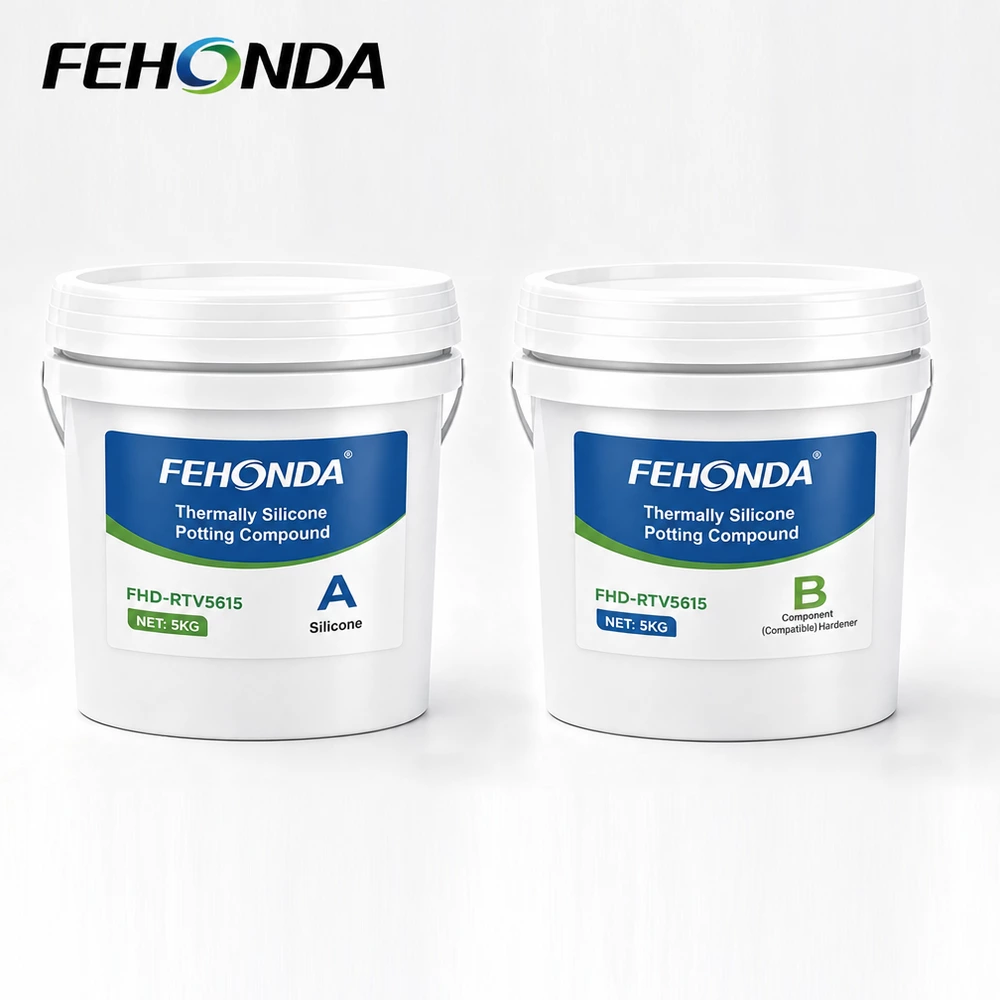
FHD-RTV5615 Two-Part Silicone Potting Compound
FHD-RTV5615 Summary
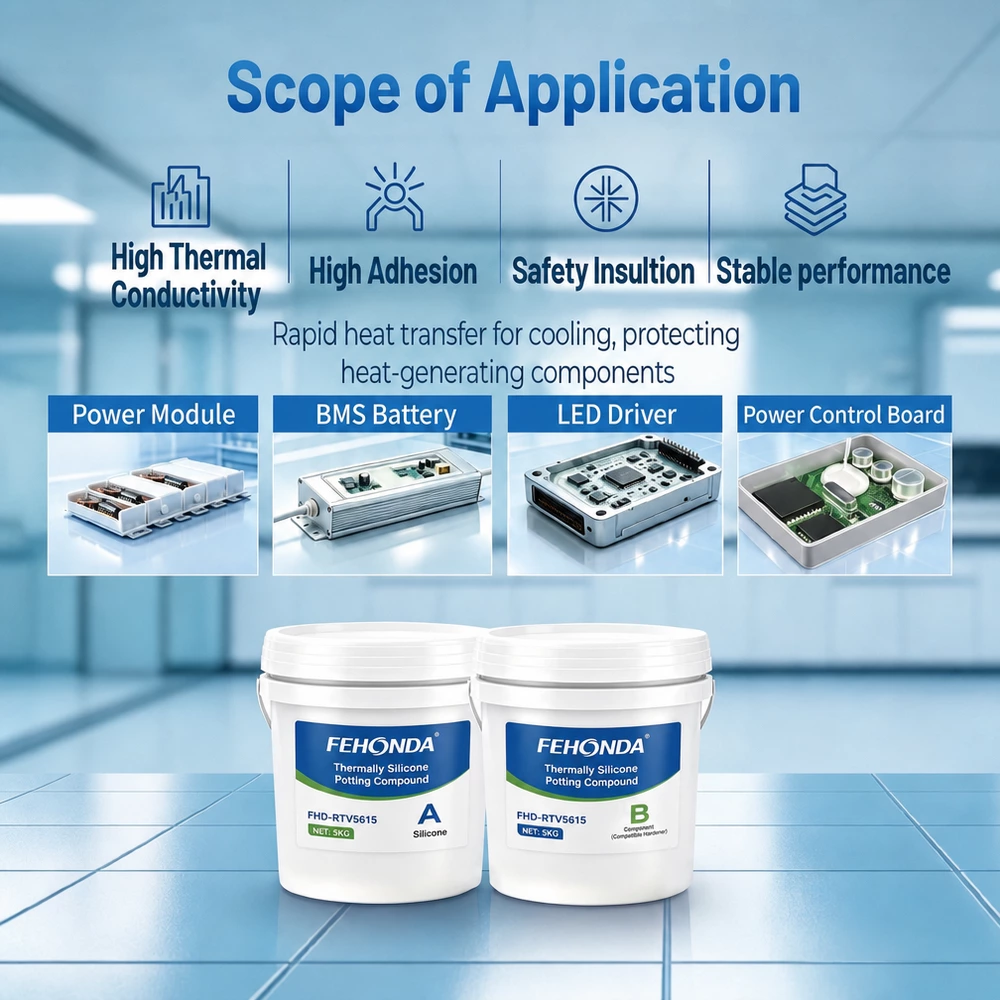
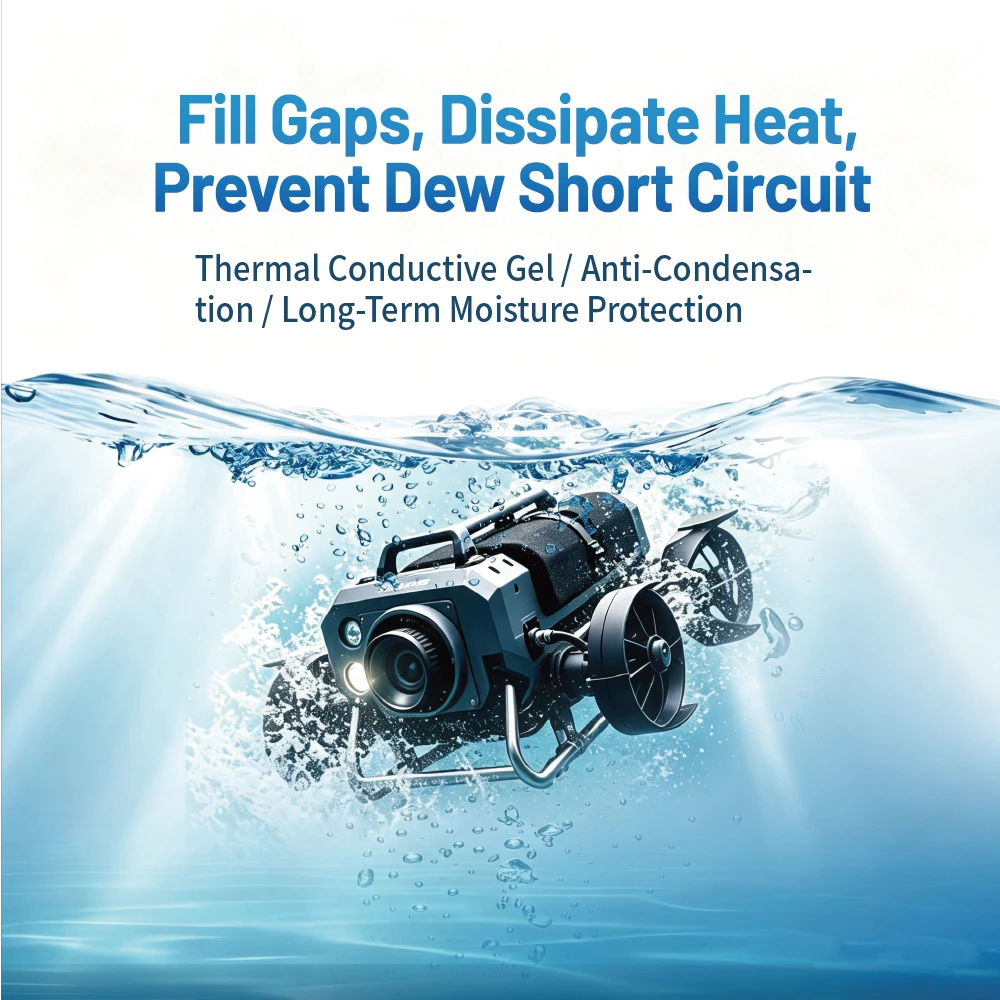
FHD-RTV5615 is a 1:1 two-part silicone potting compound for electronic components. It protects against vibration, moisture, corrosion, and dust while providing a heat path and dielectric barrier.
Unlike rigid epoxies (e.g., FHD-EP2530 at Shore D 75), it cures to a soft elastomeric gel (Shore 00 35). This softness lets the cured compound absorb movement from cure shrinkage, thermal expansion, and CTE mismatch — preventing stress from reaching solder joints, wire bonds, and ceramic bodies.








FEHONDA | Product Application Guide
A 1:1 low-stress thermally conductive silicone encapsulant — specifications, application scope, step-by-step procedure and test method
1. Full specification
The tables below reproduce the product performance data as stated in the FEHONDA datasheet. Values are typical figures obtained under standard laboratory conditions on fully cured specimens; confirm against the current datasheet before design work.
Uncured properties
| Property | Unit | Value | Test method |
| Part A appearance | — | White | Visual |
| Part B appearance | — | Grey | Visual |
| Mix ratio | by weight | 1:1 | — |
| Mixed viscosity | mPa·s | 3490 | Viscometer |
| Pot life at 25 °C | minutes | 120 | — |
| Cure time at 25 °C | hours | 24 | — |
| Cure time at 100 °C | minutes | 60 | — |
Cured properties
| Property | Unit | Value | Test method |
| Thermal conductivity | W/(m·K) | 1.5 | ASTM |
| Hardness | Shore 00 | 35 | ASTM D2240 |
| Density | g/cc | 2.41 | ASTM |
| Dielectric strength | kV/mm | 12.62 | ASTM D149 |
| Volume resistivity | Ω·cm | 1.58 × 10¹⁴ | ASTM D257 |
| Flame rating | — | V-0 | UL 94 |
| Service temperature range | °C | –40 to +180 | — |
FHD-RTV5615 Key Properties
- Hardness: Shore 00 35 (extremely soft). Deforms under light finger pressure, cushioning components instead of stressing them.
- Thermal conductivity: 1.5 W/m·K (vs. epoxy’s 3.0). Trade-off: choose this silicone when stress relief, reworkability, or wide temperature cycling matters more than peak heat transfer.
- Volume resistivity: 1.58 × 10¹⁴ Ω·cm — roughly 1000× higher than epoxy. Ideal for high-impedance circuits, sensitive sensing nodes, and optical modules where leakage must be negligible.
- Dielectric strength: 12.62 kV/mm (lower than epoxy’s 18.26). Dielectric strength measures breakdown voltage; volume resistivity measures leakage current. Specify the one that matches your failure mode.
- Pot life: 120 min at 25°C. Shortens with larger batch size and higher ambient temperature.
- Viscosity: 3490 mPa·s, moderate with good flowability. Easily penetrates intricate cavities — ensure housings and connector gaps are sealed before dispensing.
2. Application scope
FHD-RTV5615 is specified where an assembly needs environmental protection and electrical isolation, and where the contents cannot tolerate mechanical stress. The four principal areas below come directly from the product datasheet.
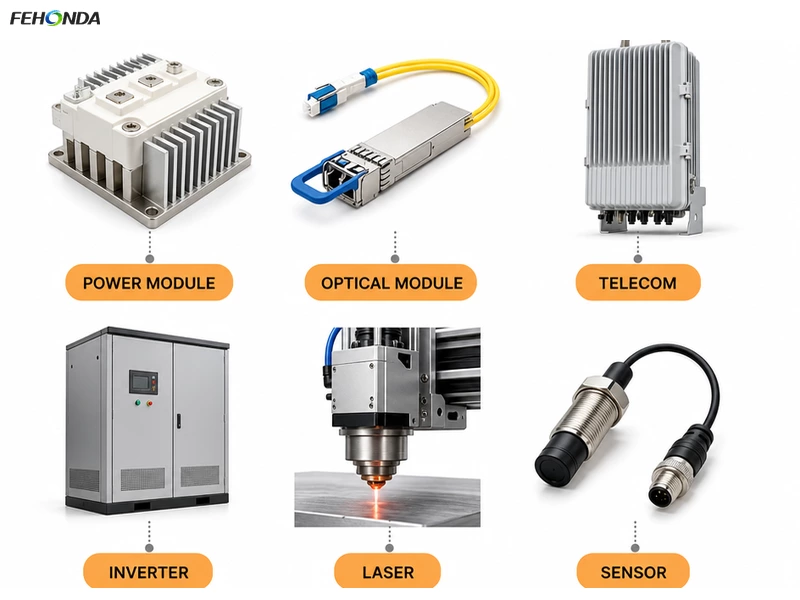
Figure 1. Principal application areas for FHD-RTV5615.
| Area | Typical potted assembly | Why a soft silicone gel is the right choice |
| Power modules | IGBT and MOSFET modules, power supplies, converter and inverter stages | Low stress protects the module's internal wire bonds, solder layers and ceramic substrate from cure shrinkage and thermal cycling fatigue |
| Optical fibre modules | Optical transceivers, fibre termination and coupling assemblies | Optical alignment is sensitive to sub-micron movement; a rigid encapsulant that shrinks on cure can shift alignment, while a soft gel holds position without loading the assembly |
| Telecommunications equipment | Base station electronics, outdoor cabinets, network line cards | Wide ambient swings and moisture sealing, combined with the option to cut the gel away for field service and rework |
| Inverters and ultra-high power lasers | High-power inverter stages, laser diode drivers and pump modules | Manages heat at 1.5 W/(m·K) while insulating at 12.62 kV/mm and cushioning high-value optical and power components |
| Sensors and connectors | Automotive and industrial sensors, sealed connectors, cable glands | Seals against moisture and corrosion while allowing a compliant body around delicate sensing elements |
| General electronics requiring rework | Prototype builds, low-volume assemblies, serviceable units | Unlike cured epoxy, a soft silicone gel can be cut away and the assembly reworked |
The thread running through all six is the same: these are assemblies where the encapsulant is expected to protect without holding rigidly, and where access for service or the tolerance of delicate geometry matters more than maximum heat transfer.
3. Silicone or epoxy: choosing between FHD-RTV5615 and FHD-EP2530
Both products are two-part, 1:1, thermally conductive, UL94 V-0 rated, and rated across the same –40 °C to +180 °C service range. The decision between them comes down to what the cured material should do mechanically.
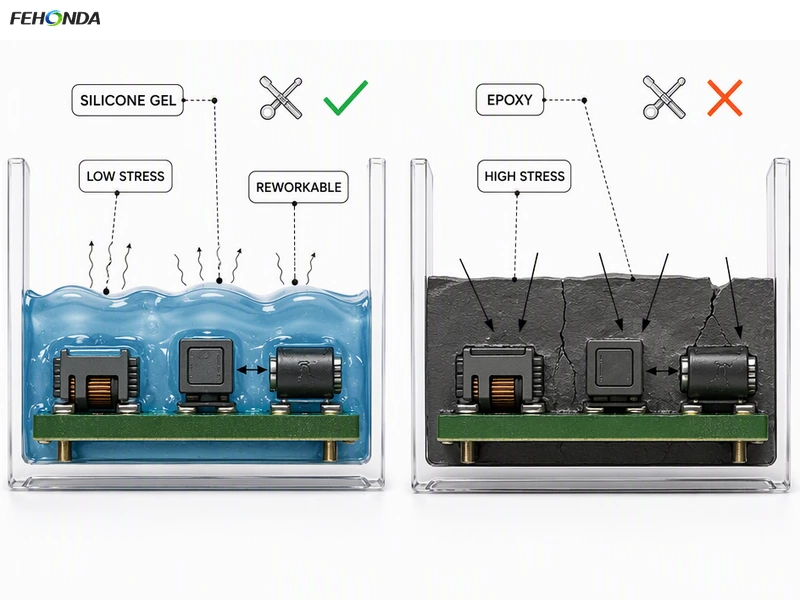
Figure 2. The core difference: a soft gel absorbs stress and can be reworked; a rigid epoxy transmits stress and cannot.
| Property | FHD-RTV5615 (silicone) | FHD-EP2530 (epoxy) |
| Cured hardness | Shore 00 35 — soft gel | Shore D 75 — rigid solid |
| Thermal conductivity | 1.5 W/(m·K) | 3.0 W/(m·K) |
| Density | 2.41 g/cc | 2.75 g/cc |
| Dielectric strength | 12.62 kV/mm | 18.26 kV/mm |
| Volume resistivity | 1.58 × 10¹⁴ Ω·cm | 3.06 × 10¹¹ Ω·cm |
| Mixed viscosity | 3490 mPa·s | / |
| Pot life at 25 °C | 120 min | / |
| Cure at room temperature | 24 h | 48 h |
| Cure under heat | 60 min at 100 °C | 150 min at 80 °C |
| Stress behaviour | Absorbs shrinkage and thermal movement | Transmits shrinkage and thermal movement |
| Reworkability | Can be cut away and reworked | Effectively not reworkable |
| Structural contribution | Protective, minimal structural support | Load-bearing and structurally supportive |
The decision rule
- Choose FHD-RTV5615 when the assembly contains stress-sensitive parts — fine-pitch BGA packages, large ceramic capacitors, wire bonds, or optically aligned components — or when the unit may need to be opened for service.
- Choose FHD-EP2530 when the potting is expected to carry load and hold parts in place, or when thermal conductivity is the dominant requirement and twice the figure matters.
- If you are undecided, the deciding test is usually a thermal cycling trial on real hardware. A rigid encapsulant that passes electrical testing can still crack components after a thousand cycles.
4. Step-by-step: how to use FHD-RTV5615
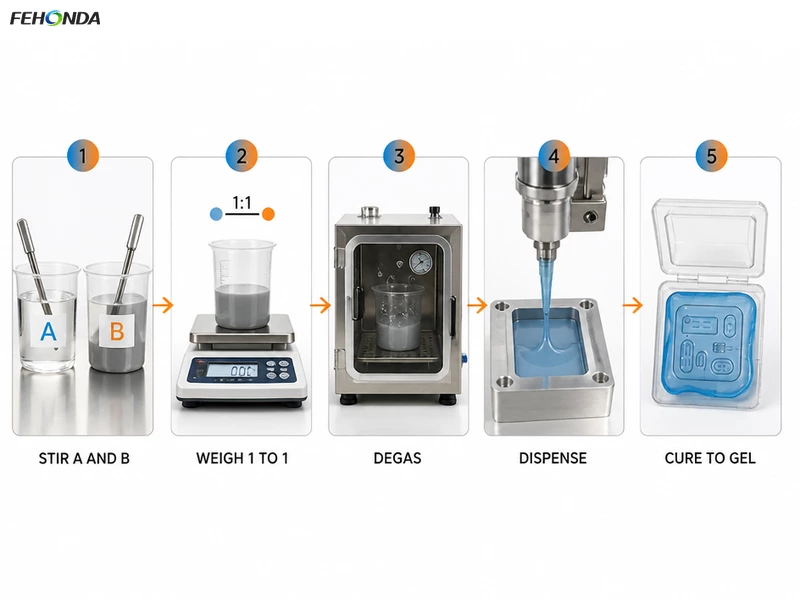
Figure 3. The five-step potting procedure.
Simplified & Corrected Application Steps for FHD-RTV5615
Step 1 — Stir
Thoroughly stir Part A and Part B in their original containers. Filled systems settle; the ceramic filler at the bottom provides the 1.5 W/(m·K) conductivity, so skipping this degrades performance. Bring to room temperature before opening if stored cool to avoid condensation.
Step 2 — Weigh & mix (1:1 by weight)
Weigh accurately on a calibrated scale. Part A is white, Part B is grey — mix slowly until completely uniform light grey with no streaking. Scrape sides and bottom repeatedly; unmixed material causes soft/tacky patches. Fast mixing traps air and shortens the 120‑minute pot life at 25 °C.
Step 3 — Degas
Vacuum degas the mixed material to remove entrained air. Place uncovered in a chamber, pull vacuum gradually to prevent overflow, hold until bubbling stops, then release slowly. Critical for optical modules where a single bubble can cause functional failure.
Step 4 — Dispense
Dispense in a slow, unbroken stream into the lowest cavity point, letting material rise and push air ahead. Moderate viscosity (3490 mPa·s) flows into intricate gaps — ensure housing, connectors, and cable entries are sealed beforehand. If using a dual cartridge with static mixer, purge upward first to expel air from the mixer.
Step 5 — Cure
Cure at 25 °C for 24 hours or 100 °C for 60 minutes. Do not disturb the assembly during cure, and do not test until fully cured (see Section 7).
Corrections made: Clarified that Part A is white and Part B is grey (consistent with product data); kept cure schedule as 100 °C/60 min (original text, not an error); ensured all steps align with FHD‑RTV5615’s soft‑gel properties and application notes.
5. How to test it
Potting compounds are tested on fully cured specimens prepared under the same mixing, degassing and cure conditions as production. The table below maps each datasheet property to the method behind it.
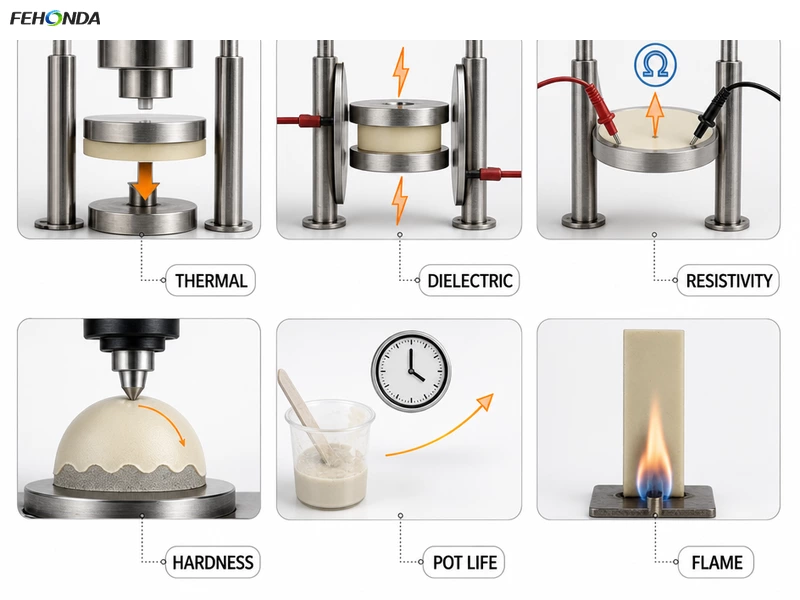
Figure 5. The six property groups measured, and the method behind each.
| Property | Method | What the test does | Why it matters here |
| Thermal conductivity | ASTM | Measures steady-state heat flow through a cured specimen of known thickness | Confirms the 1.5 W/(m·K) heat path exists in your cured part |
| Hardness | ASTM D2240 | Presses a defined indenter into the surface and measures resistance to indentation | The fastest cure-completeness and lot-consistency check. A reading well below 35 usually means under-cure, ratio error or inhibition |
| Dielectric strength | ASTM D149 | Ramps voltage across a specimen between electrodes until breakdown, then divides by thickness | Confirms the 12.62 kV/mm insulation claim; result is thickness-dependent, so compare like with like |
| Volume resistivity | ASTM D257 | Measures leakage current through the body of the material | Confirms the 1.58 × 10¹⁴ Ω·cm barrier; often decisive for high-impedance and optical assemblies |
| Pot life | — | Tracks viscosity rise or gel time of a mixed batch held at a stated temperature | Sets the practical batch size and working window on the line |
| Flame rating | UL 94 | Applies a standard flame to a vertical specimen and measures after-flame time and dripping | Confirms V-0; note the rating is certified at a specific thickness |
6. Working with FEHONDA
FEHONDA supplies a full range of thermal materials for EVs, power electronics, and optical/telecom assemblies: potting compounds, thermal silica, gels, pads, composite TIMs, and UV-curable conformal coatings.
Two core options:
- FHD-RTV5615 — soft, stress-relief silicone for reworkable encapsulation
- FHD-EP2530 — rigid, high-conductivity epoxy for structural potting
Engineering support includes: grade selection, dispensing/degassing trials, cure schedule development, adhesion screening, compliance docs, and custom formulations.
Get started: Send us your cavity geometry, substrate list, thermal budget, voltage requirement, and production volume — we'll respond with a recommendation, sample terms, and lead time.
7. Frequently asked questions
What is the mix ratio of FHD-RTV5615?
1:1 by weight. Part A is white and Part B is grey, so the colour contrast provides a visible mixing check — mix until the blend is completely uniform with no streaking.
How soft does it cure?
Shore 00 35, which places it on the softest durometer scale in common use. The cured material is a soft elastomeric gel that deforms under light pressure and absorbs stress rather than transmitting it.
What thermal conductivity does it achieve?
1.5 W/(m·K). Where maximum heat transfer is the dominant requirement, the epoxy FHD-EP2530 at 3.0 W/(m·K) is the higher-conductivity option in the same family.
Is it electrically insulating?
Yes. Cured dielectric strength is 12.62 kV/mm and volume resistivity is 1.58 × 10¹⁴ Ω·cm — the latter roughly three orders of magnitude higher than the epoxy alternative, which matters for high-impedance and optically sensitive assemblies.
How long is the working time after mixing?
120 minutes at 25 °C. That window narrows as batch size and ambient temperature increase, so size batches to what you can dispense comfortably within it.
How long does it take to cure?
24 hours at 25 °C, or 60 minutes at 100 °C. Do not test or handle the assembly until the cure is complete.
Can it be reworked?
Yes, in the sense that a cured epoxy cannot be. A soft silicone gel can be cut away to access the assembly. This is one of the main reasons to specify it for serviceable telecom and optical equipment.
When should I choose it over an epoxy potting compound?
When the assembly contains stress-sensitive parts, when it may need to be opened for service, or when very low leakage current matters more than peak thermal conductivity. Choose the epoxy when structural support or maximum heat transfer is the priority.